You see those black-and-white striped chickens everywhere. Beautiful birds, right?
But here’s the thing—most people can’t tell if they’re looking at a Barred Rock, a Dominique, or an Amrock.
I made the same mistake when I started keeping chickens twelve years ago. Bought what I thought were Barred Rocks from a local farm. Turned out they were Dominiques. The farmer didn’t even know the difference.
This confusion isn’t new. Back in 1870, the New York Poultry Society had to create official standards because people kept entering the same birds in multiple breed categories at shows. That’s how mixed up things were.
Why accurate identification matters:
You’re spending real money on these birds. Getting the wrong breed means different egg production, different temperament, and different care needs.
If you’re breeding, mixing up breeds ruins your whole program.
What you’ll learn here:
Five physical markers that separate Barred Rocks from lookalikes.
Simple stuff—comb type, barring pattern, leg color. Once you know them, identification takes five seconds.
How to spot Barred Rocks at any age, from fuzzy day-old chicks to full-grown hens. Each stage has clear tells.
Real differences between Barred Rocks and similar breeds.
Not vague descriptions—actual side-by-side comparisons that show you exactly what to look for.
Everything about their personality, eggs, and care. Because identification is just step one.
Need the quick version? Jump to the next section. It’s basically a cheat sheet.
Want the complete picture? Keep reading. I’ll walk you through everything I’ve learned raising these birds alongside Dominiques, Rhode Island Reds, and Orpingtons.
Let’s figure this out together.
How to quickly Identify?
You’ve got thirty seconds before that chicken walks away. Here’s how to know for sure it’s a Barred Rock.
The 5-Second Checklist
Look at the comb first. A single comb with five points means you’re on the right track.
Rose comb? That’s Dominique. Stop right there.
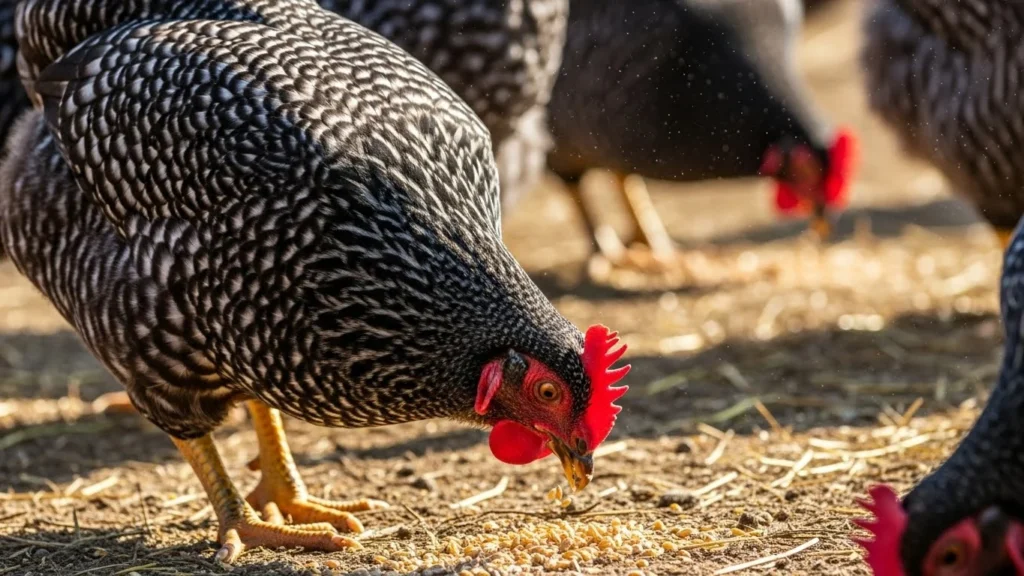
Check the barring pattern next. Straight black and white stripes running across the body—not V-shaped, not irregular. The bars should look painted on with a ruler.
Legs are yellow and clean. No feathers, no fluff. Four toes per foot.
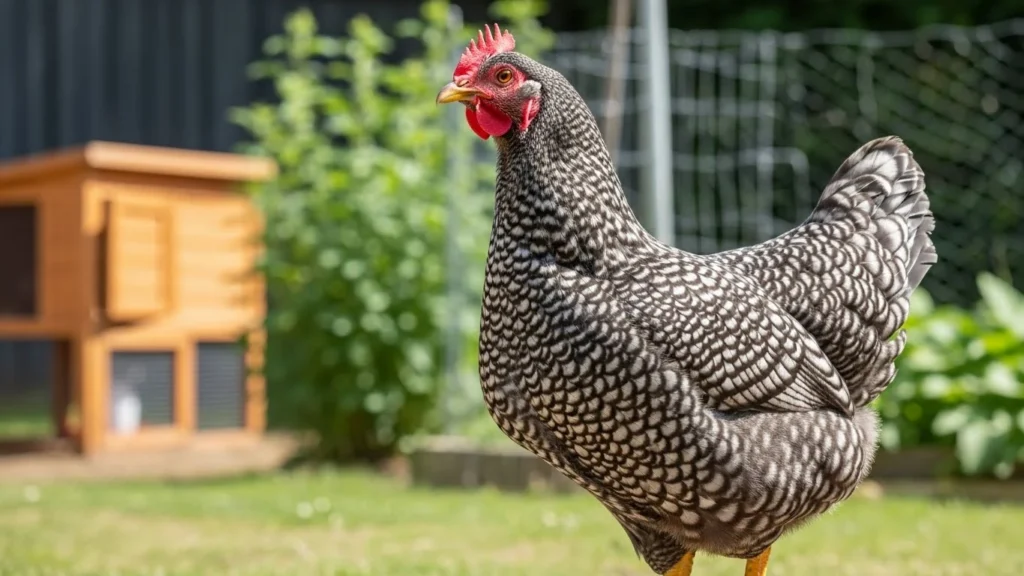
They are chunky, broad back, full chest. Not slim, not dainty.
Put it together: single comb + straight bars + yellow legs + sturdy build = Barred Rock.
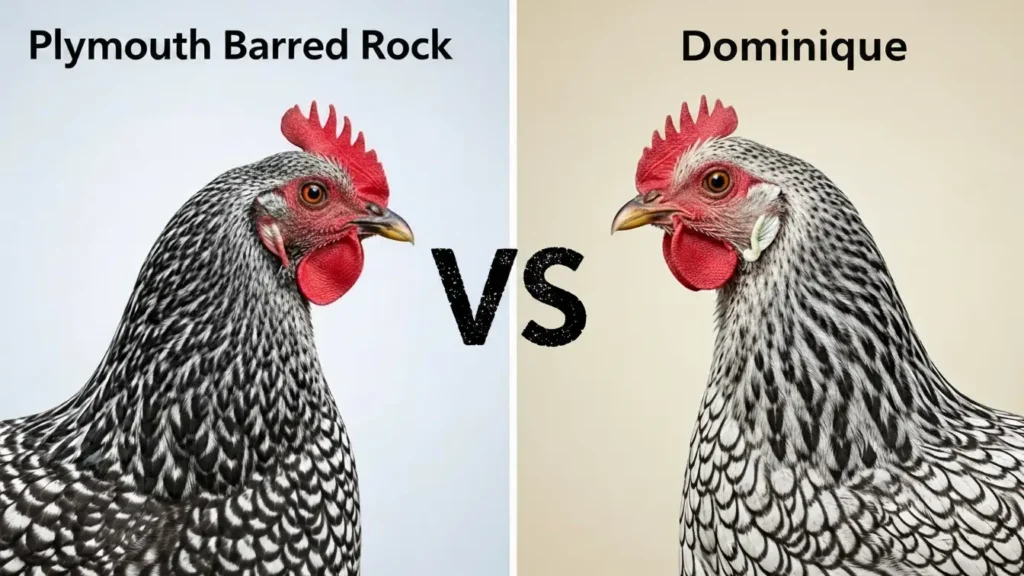
Side-by-Side Comparison
Barred Rock:
- Single comb (five distinct points)
- Straight, even black and white bars
- Yellow legs, clean shanks
- 7.5-9.5 pounds (standard size)
- American origin
Dominique:
- Rose comb (sits flat on head)
- V-shaped or irregular barring pattern
- Yellow legs, clean shanks
- 6-8 pounds
- American origin (older breed)
Amrock:
- Single comb
- Straight bars (lighter/paler than Barred Rock)
- Yellow legs
- 8-10 pounds (larger, heavier)
- European origin
Cuckoo Marans:
- Single comb
- Irregular “cuckoo” pattern (not defined bars)
- White or pinkish legs
- Upright stance
- Dark chocolate brown eggs
Steps to check quickly?
Step 1: Check the comb type
- Rose comb → Dominique (done)
- Single comb → Continue to Step 2
Step 2: Examine the barring pattern
- V-shaped or blurry → Dominique
- Irregular “cuckoo” → Marans
- Straight, defined bars → Continue to Step 3
Step 3: Look at leg color
- White or pink legs → Marans
- Yellow legs → Continue to Step 4
Step 4: Consider size and origin
- Larger bird, European line, paler barring → Amrock
- Standard size, American line, classic barring → Barred Rock
That’s it. Four steps and you’ve got your answer.
Real-World Identification Tips
The comb is your best friend.
According to experts at Cackle Hatchery, Barred Rocks have a single comb while Dominiques have a rose comb—this alone separates the two most confused breeds.
The barring tells the whole story once you know what to look for. They have sharp, straight bars.
If the pattern looks smudged or makes little V shapes, you’re looking at something else.
Don’t trust egg color alone for identification. Both Barred Rocks and Dominiques lay brown eggs.
Common Mistakes to Avoid
- Assuming all black-and-white chickens are Barred Rocks.
- Ignoring the comb type.
- Looking only at size.
What If You’re Still Not Sure?
Take a clear photo of the bird’s head (showing the comb), full body (showing the barring pattern), and legs.
Post in chicken identification groups on Facebook or BackYard Chickens forum. Experienced keepers can spot breed characteristics you might miss.
Look at the parents if possible. Purebred Barred Rocks produce Barred Rock offspring with consistent characteristics.
When in doubt, comb type never lies. Single means it could be a Barred Rock. Rose means it absolutely isn’t.
Physical Identification Features
Here’s every physical marker that defines a true Barred Rock.
The Barred Plumage Pattern
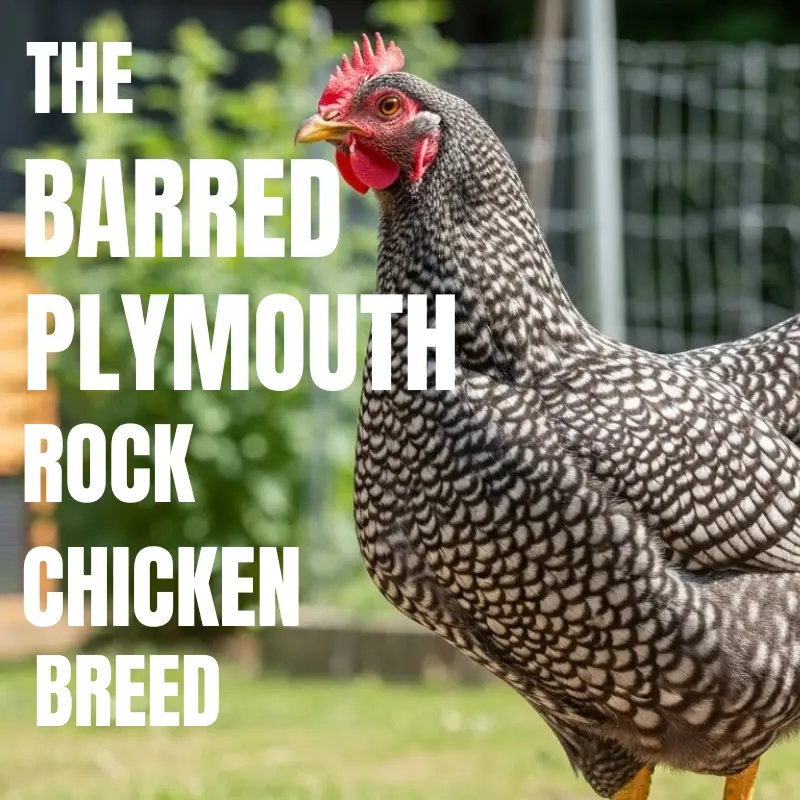
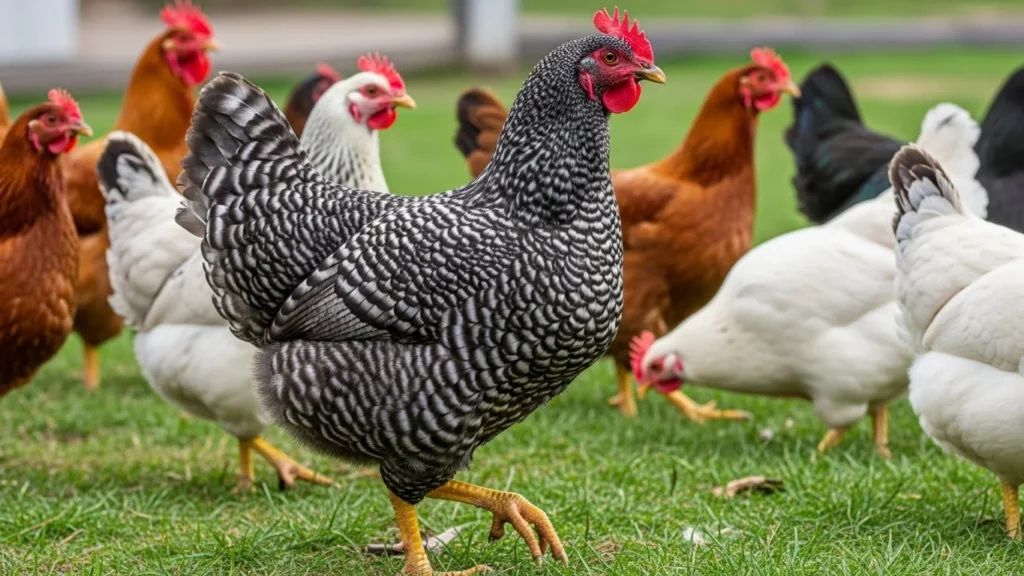
Black and white stripes run horizontally across every feather. Sharp lines, clean edges—no blurring.
According to Backyard Poultry experts, barred patterns have distinct lines, unlike murky cuckoo patterns.
Roosters look lighter than hens. They carry two barring genes, creating wider white bars.
Hens have one gene, so their black bars dominate.
This sex-linked trait is genetic. The Livestock Conservancy notes the barring gene prevents pigment on colored plumage.
The pattern stays consistent everywhere—wings, back, breast, tail.
Comb and Wattle:
Single comb with five points. Evenly serrated, standing upright. Rose comb = not a Barred Rock.
Bright red combs and wattles are a direct signal of maturity.
The Livestock Conservancy confirms they have bright red single combs, face, wattles, and red earlobes.
Body:
Broad back, full breast, horizontal carriage. That triangular shape comes from dual-purpose breeding.
Loose, fluffy feathers make them look bigger than they are.
Standard hens weigh 7.5 pounds, roosters 9.5 pounds. Bantams run 2.5-3 pounds.
The body feels solid and muscular. No delicate bones.
Legs and Feet:
Yellow legs with no feathers. Four toes per foot.
The Livestock Conservancy confirms yellow skin and legs with four toes—critical breed markers.
Chicks show sex differences early. Males have lighter orange legs, females show charcoal grey.
Roosters vs Hens
Roosters:
- 9.5 pounds average
- Lighter barring (wider white bars)
- Long, curved sickle tail feathers
- Large combs, often flopping
- Prominent spurs
- Crow and strut
Hens:
- 7.5 pounds average
- Darker barring (wider black bars)
- Short, straight tail
- Smaller, neat combs
- Minimal spurs
- Cluck and lay
Day-old sexing works. Males have larger white head spots. Females show smaller, less defined spots.
Feather Quality
Incredibly soft with full, loose texture. Dense feathering provides excellent cold insulation.
New feathers grow back with the same sharp pattern.
What Disqualifies a Barred Rock?
Not a Barred Rock if it has:
- Rose comb
- White or pink legs
- Irregular or fuzzy barring
- Feathered legs
- Five or more toes
- Wrong body shape (too slim or upright)
The American Poultry Association set these standards in 1874.
How to identify by Age?
Barred Rocks change from hatch to maturity. Here’s how to spot them at every stage.
Day-Old Chicks (0-2 Weeks)
- No stripes yet. Chicks are dark grey to black with fluffy down.
- The white spot on the head is your key identifier. Every chick from this breed has one.
- Leg color differs too. Males have orange-yellow legs. Females show charcoal grey.
- Males appear lighter overall. Females look darker with concentrated black pigment.
University studies report 90-95% accuracy when combining head spot, leg color, and down intensity.
The white spot is genetic—linked to the barring gene on sex chromosomes. Males carry two copies, females carry one.
Juveniles (3-12 Weeks)
- Start barring appears around 6-8 weeks. First on wings, then spreading across the body.
- Males develop wider white bars immediately. Females grow prominent black bars.
- Combs start reddening on males by 5-6 weeks. Females keep yellow combs longer.
- Cockerels grow taller and heavier. Pullets feather faster but stay smaller.
Hackle feathers (pointy neck feathers) develop on cockerels between 8-12 weeks. Pullets don’t get them.
Young roosters start practicing their crow. Pullets stay quiet.
Young Adults (12-20 Weeks)
- Full barring pattern is complete. Sharp, defined stripes everywhere.
- Roosters look silvery-white with black striping. Hens appear predominantly dark.
- Combs are fully developed. Roosters have large, upright five-pointed combs. Hens keep smaller combs.
- Sickle feathers appear on roosters—long, curved tail feathers. Hens have short, straight tails.
- Weight difference is clear. Roosters hit 7-8 pounds. Pullets stay around 6 pounds.
- Pullets start laying at 18-22 weeks. Cockerels are fully crowing and mating.
Mature Adults (20+ Weeks)
- Everything is fully developed. No guessing.
- Roosters weigh 9-9.5 pounds. Hens weigh 7.5 pounds.
- Behavior is completely different. Roosters crow, protect, and mate. Hens lay eggs and nest.
- Roosters stand tall and upright. Hens maintain horizontal posture.
Molting Changes (Annual)
- Adults molt once yearly, usually in fall. Feathers fall out and regrow over 8-12 weeks.
- New feathers grow back identical. Pattern doesn’t change.
- During molt, birds look patchy. This is normal.
- Egg production stops during heavy molt. Resumes after full regrowth.
Quick Age Reference
0-6 weeks: Use head spot, leg color, down intensity
6-12 weeks: Watch barring emergence and comb development
12-20 weeks: Tail feathers and body size confirm sex
20+ weeks: Full adult characteristics, behavior tells all
Plymouth Rock Varieties
“Barred Rock” and “Plymouth Rock” aren’t two different breeds. Plymouth Rock is the breed. Barred is the color variety.
Plymouth Rock: The Breed
Plymouth Rocks first appeared in Boston in 1849, disappeared, then returned in 1869 in Worcester, Massachusetts.
The American Poultry Association recognized them in 1874. They’ve been an official American breed for 150 years.
According to The Livestock Conservancy, they graduated from the conservation priority list in 2023 due to recovered populations.
They’re dual-purpose—raised for both eggs and meat.
All Seven Recognized Varieties
The APA recognizes seven color varieties:
Barred: Black and white stripes. Original and most popular.
White: Solid white plumage. Second most common.
Buff: Light tan coloring throughout.
Blue: Slate-blue with darker lacing. Rare.
Black: Solid black with green sheen. Occasional.
Columbian: White body with black neck and tail.
Partridge: Brown and black pattern. Very rare.
Silver Penciled: White with black penciling. Extremely rare.
Only barred and white are commonly available. The others are hard to find.
What All Varieties Share?
Structure and temperament are identical across all varieties. Only feather color differs.
Why Barred Is Most Popular?
You can sex chicks at hatch by head spot size.
The pattern is striking and unique. Instantly recognizable.
Barred Rocks have been available for 150+ years. Every major hatchery carries them.
Harvey Ussery, author of The Small Scale Poultry Flock, calls them a “quintessential rock-solid American farm breed.”
They were “America’s favorite breed” through the early 1900s.
Bantam Plymouth Rocks
The American Bantam Association recognizes bantam versions of all varieties.
Bantams weigh 2.5-3 pounds—one-third the size of standards.Same temperament and hardiness. Lay smaller eggs. Need less space and feed.
Good for urban settings with size restrictions.
How to find Rare Varieties?
Only barred and white are readily available from major hatcheries like Meyer, Cackle, and Murray McMurray.
For rare colors, contact the Plymouth Rock Fanciers Club (founded 1973) or attend poultry shows.
Expect to wait and pay more. Some rare varieties are nearly extinct outside specialty breeding programs.
Why “Barred Rock” Stuck
People shortened “Barred Plymouth Rocks” to “Barred Rocks” for simplicity.
The name became so common that many don’t realize Plymouth Rock is the actual breed.
Correct terminology: Plymouth Rock is the breed, barred is the variety.
But most backyard keepers just say “Barred Rock” and everyone understands.
Complete Breed Characteristics Profile
Everything you need to know about Barred Rocks beyond identification.
Temperament and Personality
Barred Rocks are genuinely calm, docile, and friendly. They follow you around the yard, especially for treats. Friendly without being needy.
Hens sit middle-to-low in pecking order. They don’t pick fights in mixed flocks.
Some hens become lap chickens. Others stay friendly but independent.
Kids do well with the hens. Gentle, easy to handle, not flighty.
They’re relatively quiet. Soft clucking and cooing. The egg song can get loud though.
Broodiness happens 1-2 times yearly if conditions trigger it. They make attentive mothers.
Egg Production
Output: 200-280 large brown eggs per year. That’s 4-5 eggs weekly.
Heritage strains lay 200-220 eggs but maintain production longer. Production strains hit 250-280 but taper off sooner.
Pullets start laying at 18-22 weeks. Some early birds begin at 16 weeks.
Shell color is light to medium brown. Uniform, no speckles.
Winter laying continues when other breeds quit. Major advantage. But production drops 10-15% annually after peak years.
Some hens keep laying at reduced levels for 8-10 years. Others stop by age 6-7.
Climate Adaptability
Cold hardiness: Exceptional. Dense feathering provides natural insulation.
They forage happily in snow. Handle extreme cold with dry shelter.
Frostbite risk on combs and wattles, especially roosters. Apply petroleum jelly during extreme cold. Sweeter Heaters over roosting bars recommended.
Heat tolerance: Good but not exceptional. Need shade and fresh water above 90°F.
Dense feathering works against them in heat. Look them for heat stress.They adapt to most climates with proper management.
Health and Hardiness
Naturally healthy birds. No breed-specific genetic problems.
Standard chicken issues apply—mites, lice, worms, respiratory infections. Nothing unusual.
What is the Lifespan?
Lifespan averages 6-8 years in backyard settings. Some reach 10-12 years.
Foraging and Free-Range Behavior
Excellent foragers. They hunt bugs, scratch leaves, and cover good territory.
Barred pattern provides camouflage from hawks. Harder to spot than solid colors. Adventurous but not escape artists. Stay close to home base.
Are they Dual Purpose?
Eggs: Primary strength. Reliable year-round layers.
Meat: Decent but not impressive. Dressed weight 5-7 pounds at 16-20 weeks.
Flavorful meat with good texture. Abundant dark meat.
Modern meat breeds outproduce them. Most backyard keepers focus on eggs.
Noise Level
Hens make moderate noise. Egg songs can be loud. Soft clucking during the day. Not constantly noisy.
Roosters crow frequently, starting before dawn. Problem for close neighbors.
But after all, we can say they are quieter than Leghorns. Louder than truly quiet breeds.
Are they can Fly?
Yeah! They can fly 4-6 feet when motivated. Not exceptional but capable.
Beginner Suitability
Obviously, they are the perfect starter breed. Forgiving of mistakes, hardy, consistent.
No special care beyond standard chicken keeping. Calm temperament makes handling easy.
Reliable eggs give immediate rewards.
According to multiple hatcheries, they rank in top 5 beginner breeds consistently.
Practical Care and Housing Requirements
Here’s what Barred Rocks actually need to thrive in your backyard.
Space Requirements
Coop: 4 square feet per bird if free-ranging daily. After experiencing, I notice heavy breeds like Barred Rocks need this much indoor space.
Confined birds need 5 square feet per bird. Pet Chicken experts report 4 square feet keeps their Barred Rocks peaceful and drama-free.
Run: 8-10 square feet per bird in covered runs.
Free-range: Best with access to larger foraging areas.
For 6 hens, you need a minimum 24 square feet (4×6 coop). For 10 hens, aim for 40-50 square feet.
Roosting Requirements
Roost space: 10-12 inches per bird. They’re large and need elbow room. Bars should be 2-3 feet high. Use 2×4 lumber, wide side up.
Install bars away from walls for air circulation. Prevents frostbite on combs. Don’t place bars directly above each other. No one wants poop on their head.
Poop boards under roosts make cleanup easier. Scrape daily or every few days.
Nesting Box Setup
One box per 3-4 hens. For 10 hens, provide 3 boxes.
Standard 12x12x12 inches works fine. Place boxes lower than roost bars. Chickens sleep in the highest spot.
Dark, quiet corners reduce egg-eating behavior.
Ventilation Essentials
Yes, it is critical for health. Poor ventilation causes respiratory issues.
Provide 1 square foot of permanent ventilation per bird above roosting height.
According to BackYard Chickens guidelines, ventilation should be 24/7/365—not something you open and close.
Coop Design:
Predator-proof: Hardware cloth (not chicken wire) on windows and vents. Bury wire 12 inches underground.
Easy access: You’ll clean weekly. Make doors accessible without crawling.
Weatherproof: Solid walls on three sides. Roof overhang for rain protection.
Flooring: Dirt, concrete, or wood all work. Each has pros and cons.
Feeding Guidelines
Daily feed: 1/4 to 1/3 pound (about 1/2 cup) layer pellets per bird.
Protein: 16-18% for adults, 18-24% for chicks.
Hang feeders at chest height. Reduces waste.
Free-choice calcium: Oyster shell in separate container for strong shells.
Water: Fresh water constantly available. Change daily. One gallon per 4-5 birds.
Bedding and Cleaning
Bedding: Pine shavings work great. Add fresh bedding weekly on top. Clean out 2-3 times yearly.
Remove all bedding weekly, scrub monthly. Spot-clean poop boards daily. It takes 5 minutes.
Health Maintenance
Weekly: Observe behavior, check vents, watch for limping.
Monthly: Handle each bird. Check for lice/mites, examine feet for bumblefoot.
Parasite prevention: Provide dust baths. Mix food-grade diatomaceous earth into bedding. Worm every 6 months if needed.
Equipment You may needed:
Essential:
- Feeder (hanging or elevated)
- Waterer (1 gallon per 4-5 birds)
- Roosting bars
- Nesting boxes
- Bedding material
- Dust bath container
Recommended:
- Poop boards
- First aid kit
- Predator-proof latches
- Outdoor thermometer
Common Mistakes
When you are going to start, maybe you make some of the mistakes that most beginners do.
- Undersizing the coop.
- Using chicken wire instead of hardware cloth.
- Skimping on ventilation. Kills more chickens than cold ever will.
- Placing waterers inside the coop. Spills create dampness and parasites.
- Overcrowding. Causes stress, pecking, decreased production.
Comparison with Other Beginner Breeds
vs Rhode Island Red: They have calm temperament, good cold hardiness, slightly lower eggs (200-280 vs 250-300)
vs Australorp: Similar temperament, lower production (200-280 vs 250-300), more striking appearance
vs Buff Orpington: Higher egg production (200-280 vs 180-200), less broody, similar size
vs Wyandotte: Similar production and hardiness, different pattern preferences
Setting Suitability
Urban: Hens only.
Rural: Ideal. Plenty of free-range space. Rooster crowing is not a problem.
Realistic Expectations
They’re excellent all-around birds but not perfect at anything.
Good egg production, not exceptional. Strong health, not invincible. Friendly temperament, not lap-chicken level.
BackYard Chickens reviewers call them “jack-of-all-trades”—solid, reliable, dependable, not flashy.
They eat more than smaller breeds. Factor food costs.
Rooster temperament is unpredictable. Some are protective, others turn hostile.
How to Select Quality Birds?
For Chicks
Good signs:
- Alert, active behavior
- Clear, bright eyes
- Clean vent
- Steady on feet
- Fluffy, clean down
Red flags:
- Lethargic behavior
- Discharge from eyes/nose
- Labored breathing
- Crooked beaks or legs
- Wet or dirty vents
For Adult Birds
Healthy adults show:
- Bright red comb and wattles
- Clear, alert eyes
- Clean, well-formed feathers
- Smooth gait
- Active behavior
Avoid:
- Pale combs
- Discharge from any opening
- Damaged feathers
- Labored breathing
- Visible parasites
Ask about vaccination history, age, and production records.
Questions Before Buying
Ask hatcheries:
- Production or heritage strain?
- Vaccination options?
- Minimum order?
- Live arrival guarantee?
Ask breeders:
- Can I see parent birds?
- Vaccination history?
- Age and production records?
Get clear answers before committing.
Red Flags
Avoid sellers who:
- Won’t show parent birds
- Have sick or stressed birds visible
- Can’t provide health history
- Have dirty, overcrowded facilities
Trust your gut. Walk away from questionable situations.
After Purchase
Quarantine new birds for 30 days. Keep separate from the existing flock.
Observe behavior daily. Note eating, drinking, droppings.
Integration takes time. Introduce gradually after quarantine.
The Bottom Line
Most backyard keepers do fine with hatchery stock from Cackle, Murray McMurray, or Meyer.
Exhibition breeders matter only for showing or serious breeding.
Always prioritize health over appearance. Buy from reputable sources with good reviews.