Four hundred chicken breeds. To pick one, obviously overwhelming.
Want to know which ones actually fit your backyard, climate, and goals?
You see guides of breeds listed, but not feel well or unsure till now.
Ok! I bet you’ll never be disappointed here.
The Problem
Mostly, new chicken keepers choose breeds based on pretty feathers, maximum egg counts, or friend recommendations.
And after a time, their fancy chickens can’t see predators. Their high-production layers burn out in two years. Their Mediterranean breeds get frostbite in cold climates.
According to the BackYard Chickens forum, 30% of new keepers quit within the first year. Usually because they chose wrong.
The Solution: 7-Factor Framework
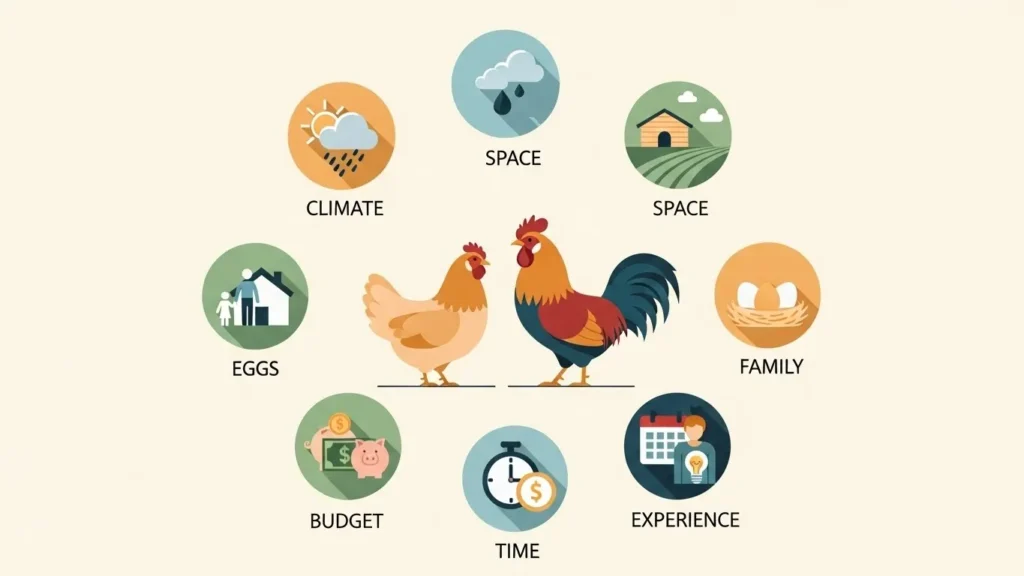
Let’s work on seven factors systematically. You’ll narrow 400+ breeds down to 3-5 perfect matches.
Factor 1: Primary Purpose – Eggs, meat, dual-purpose, or pets?
Factor 2: Climate – Cold-hardy or heat-tolerant?
Factor 3: Space – Urban, suburban, or rural?
Factor 4: Experience Level – Beginner or advanced?
Factor 5: Time Available – Low or high maintenance?
Factor 6: Family Situation – Kids or adults only?
Factor 7: Budget – Initial costs and ongoing feed expenses?
Each factor eliminates incompatible breeds. By the end, you’ll have specific recommendations matched to YOUR situation.
What You’ll Get
- Clear priorities for your specific situation.
- Breed recommendations that actually fit.
- Realistic expectations about care and production.
- Common mistakes to avoid.
- No more guessing. Just smart, informed decisions.
Let’s find your perfect chickens.
The Decision Framework: 7 Critical Factors
Most people choose breeds backwards. They fall in love with pretty birds, then try forcing them into their situation.
Think of it like filters. Start with 400+ breeds, apply seven filters, end up with 3-5 perfect matches.
Overview of 7 Factors
Factor 1: Primary Purpose
Eggs, meat, dual-purpose, or pets? This question eliminates 60% of breeds immediately.
Egg machines make terrible pets. Meat birds can’t lay. Ornamental breeds produce little except beauty.
Factor 2: Climate
According to Ohio State Extension, climate matching is critical for flock health and productivity.
Factor 3: Available Space
Urban backyards, suburban lots, and rural properties need different breeds.
Active Leghorns go crazy in tight spaces. Massive Jersey Giants need room to move.
Factor 4: Experience Level
Some breeds forgive beginner mistakes. Others punish them immediately.
Grubbly Farms notes that matching breeds to your skill level keeps chickens healthier and cared for.
Factor 5: Time & Maintenance
Got 15 minutes daily? Some breeds work fine. Need an hour? That’s high-maintenance most people can’t sustain.
Factor 6: Family Situation
Kids change everything. According to The Chicken Chick, temperament matters enormously for family harmony.
Factor 7: Budget
Feed costs vary 200% between small and giant breeds.Ongoing costs add up fast with wrong breed choices.
How This Framework Works?
Answer each factor honestly. Not aspirationally. HONESTLY.
Each answer eliminates incompatible breeds. By Factor 7, you have a short list of compatible options.
Real Example:
Factor 1: “Want eggs for family of 4” → Keeps layers and dual-purpose
Factor 2: “Minnesota, winters -20°F” → Keeps cold-hardy breeds only
Factor 3: “Small suburban backyard, 400 sq ft” → Keeps calm medium-sized birds
Factor 4: “First-time keeper” → Keeps beginner-friendly breeds
Factor 5: “Can spare 20-30 minutes daily” → Keeps low-maintenance breeds
Factor 6: “Two kids ages 6 and 9” → Keeps gentle kid-friendly breeds
Factor 7: “Moderate budget” → Keeps common productive breeds
Result: Buff Orpington, Australorp, Plymouth Rock, Wyandotte
Seven questions, one clear answer. No confusion.
Why Each Factor Matters?
Purpose determines everything. Want pets? Production doesn’t matter. Want eggs? Temperament matters less.
Climate is biology. Mediterranean breeds get frostbite in the cold. Cochins suffer heat stroke in Arizona.
Space is physical reality. Four square feet per bird minimum. Active breeds need more.
Experience protects beginners. Michigan State Extension notes skill-matched breeds prevent frustration and losses.
Time determines sustainability. High-maintenance breeds requiring daily grooming aren’t sustainable for busy people.
Family dynamics affect daily life. Aggressive roosters near toddlers create danger. Match breeds to your household.
Factor 1: Define Your Primary Purpose
What do you actually want from these chickens? Be honest.
The Four Categories
Laying Breeds (Egg Production)
Production: 250-320 eggs/year (peak years 1-2)
Body: Lean, 4-5 pounds, minimal meat
Temperament: Active, flighty
Lifespan: Productive 2-3 years, total 3-5 years
University of Delaware Extension notes nutrients go to eggs, not body weight.
Top layers:
- ISA Brown (300-350)
- White Leghorn (280-320)
- Golden Comet (280-320)
Reality: Burn bright and fast. ISA Browns drop from 300 eggs to 150 by year three.
Meat Breeds
Growth: Ready 6-12 weeks
Body: Heavy, muscular
Eggs: 50-100/year (poor)
Ohio State Extension notes meat birds need high protein (20-24%) and large feed amounts.
Top meat: Cornish Cross (8-10 lbs in 8 weeks).
Truth: Cornish Cross past 12 weeks get heart attacks. Butcher or they die.
Dual-Purpose (Both Eggs & Meat)
Eggs: 200-280/year
Meat: 6-9 pounds at 16-20 weeks
Lifespan: 6-10 years total, productive 4-6 years
The Happy Chicken Coop notes classic breeds like Orpingtons lay lots of eggs and provide butchering value.
Top choices: Rhode Island Red (250-280 eggs), Plymouth Rock (200-280), Orpington (200-280), Wyandotte (200-250)
Why they work: Eggs for years. Process roosters at 16-20 weeks. Flexible.
Ornamental (Pets & Show)
Production: 100-180 eggs/year
Purpose: Beauty, personality
Popular: Silkies (lap chickens, 100-120 eggs), Polish (crazy feathers, 120-150), Frizzles (curly feathers, 120-160)
Reality: Kept for joy, not practicality.
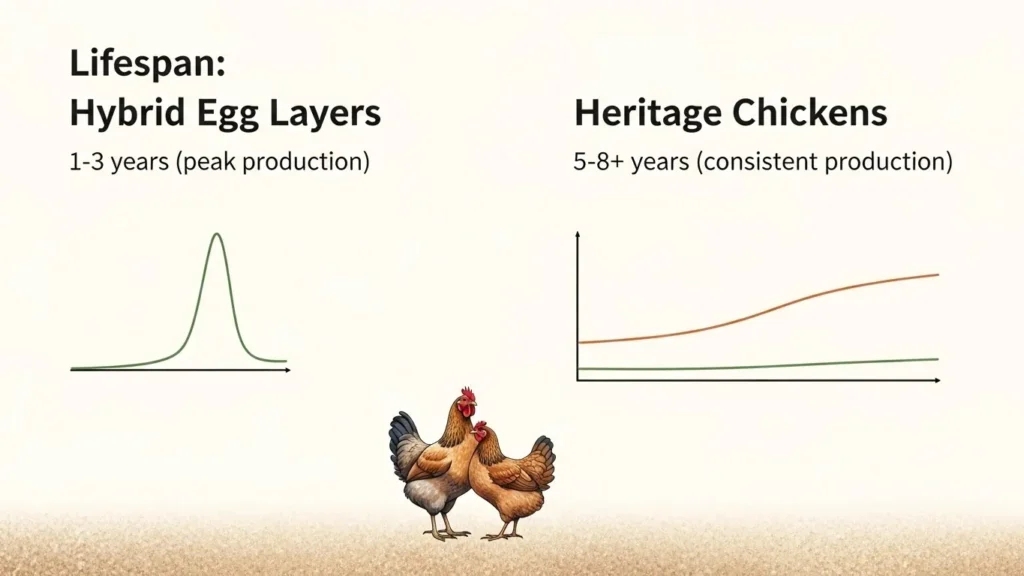
Hybrid vs Heritage:
Production Hybrids: 280-320 eggs year one, crash after year 2, lifespan 3-5 years.
Heritage Breeds: 180-280 eggs/year, maintain 4-6 years, lifespan 6-10+ years.
Examples are:
Want eggs for family of 4: 4-5 Golden Comet or Australorp hens → 20+ eggs weekly
Want eggs + meat: Plymouth Rock or Orpington → eggs from hens, process roosters
Want pets: Silkies or Buff Orpingtons → focus on handling
Want freezer meat: Cornish Cross → 15-25 birds, process 8-12 weeks
Dakota Storage Buildings find out that you need at least 18 meat chickens per person annually if you are the regular meat consumer.
Your Decision
- Maximum eggs? → Egg layers
- Fill the freezer with meat? → Meat breeds
- Eggs + butcher option? → Dual-purpose
- Fluffy pets? → Ornamentals
- Sustainable flock? → Heritage dual-purpose
Your answer eliminated 60% of breeds.
Factor 2: Climate Dependence
Climate isn’t negotiable. Minnesota winters kill Mediterranean breeds. Arizona summers kill heavily-feathered giants.
Backyard Poultry confirms choosing climate-adapted breeds is critical—wrong choice causes suffering and death.
Why Does Climate Matters?
Chickens regulate temperature through combs, wattles, and breathing. They can’t sweat.
Cold problems: Frostbite, reduced laying, hypothermia
Hot problems: Heat stroke, stopped laying, death above 100°F
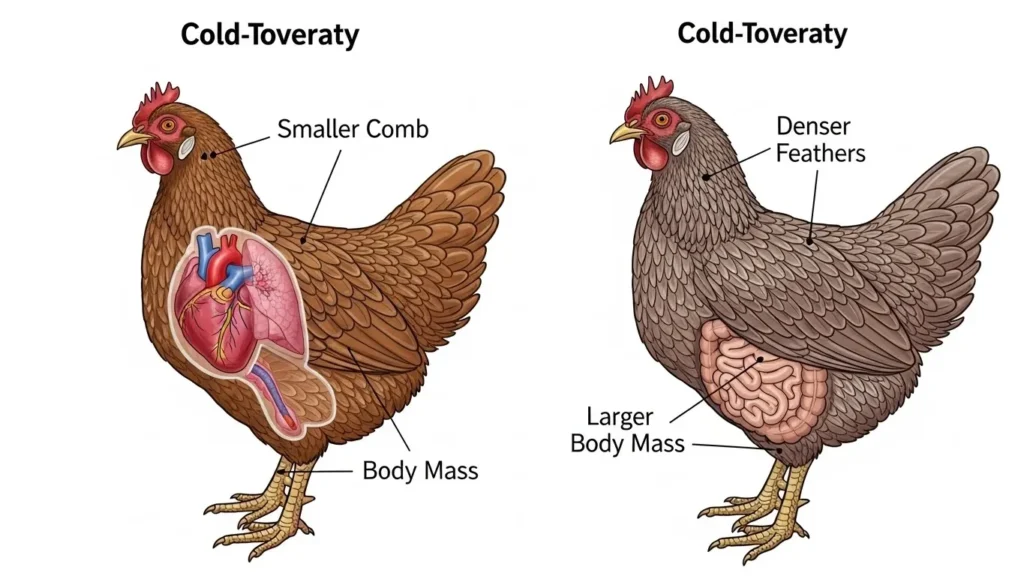
Cold Climate Breeds (Winters Below 20°F)
Key traits: Small combs/wattles, dense feathering, heavier body, often feathered feet
Top cold-hardy breeds:
- Brahma – Small pea comb, heavily feathered feet
- Wyandotte – Rose comb, dense plumage, 200-250 eggs
- Orpington – Massive fluffy feathers, 200-280 eggs
- Cochin – Foot feathering, heavy down
- Australorp – Black absorbs heat, 250-300 eggs
- Plymouth Rock – Dense feathering, 200-280 eggs
- Rhode Island Red – Hardy, productive, 250-280 eggs
- Easter Egger – Pea comb, colorful eggs
- Sussex – Cold-tolerant, friendly
- Dominique – Rose comb, America’s oldest
Winter care: Ventilation without drafts, petroleum jelly on combs, dry bedding, liquid water
Avoid in cold: Leghorn (large comb), Silkie (feathers not waterproof), Mediterranean breeds, small bantams
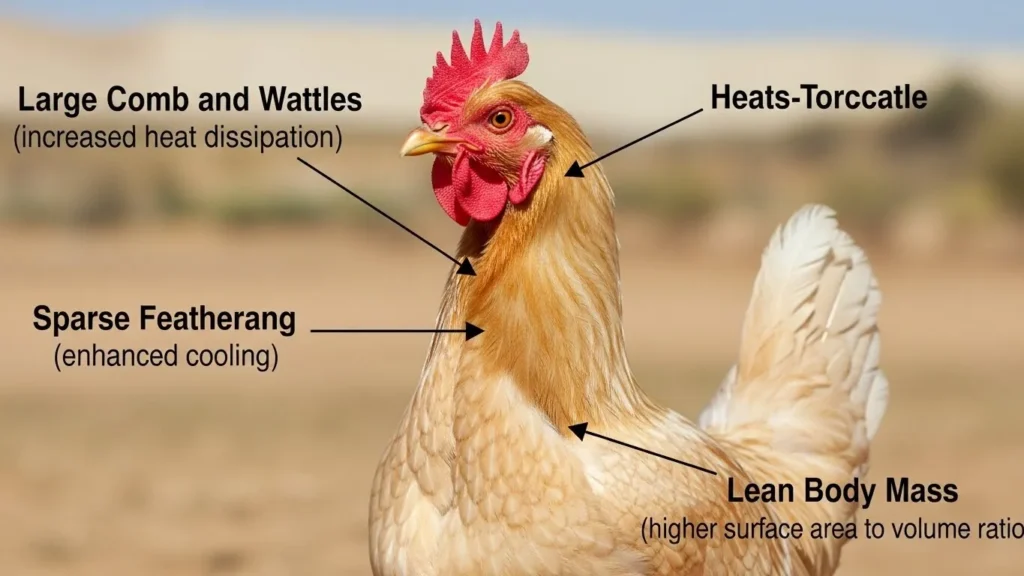
Hot Climate Breeds (Summers Above 90°F)
Key traits: Large combs/wattles, lightweight bodies, less feathering, light plumage
Top heat-tolerant breeds:
- White Leghorn – Large comb, light body
- Rhode Island Red – Adaptable to both extremes
- Australorp – Handles heat despite dark color
- Easter Egger – Generally adaptable
- Barred Plymouth Rock – Clean legs, moderate feathering
- Naked Neck – 40% less feathering
- Andalusian – Mediterranean, lightweight
- Delaware – Thrives in heat and cold
- Welsummer – Handles heat well
- Minorca – Large comb, Mediterranean
Summer care: Multiple shade structures, fresh water (change often), frozen treats, misters/fans
Avoid in heat: Cochin, Brahma, Orpington (heavy feathering), Silkie (can’t regulate temperature)
Moderate Climate Breeds (20-85°F)
All-around adaptable: Plymouth Rock, Rhode Island Red, Australorp, Wyandotte, Sussex, Easter Egger, Delaware
Extreme Climate (Both Cold AND Hot)
Best for -20°F winters + 100°F+ summers:
- Rhode Island Red
- Australorp
- Easter Egger
- Plymouth Rock
- Delaware
Require seasonal management: summer shade/water/misters, winter dry coop/ventilation/petroleum jelly.
Grit magazine warns even heat-tolerant breeds can die during extreme heat waves.
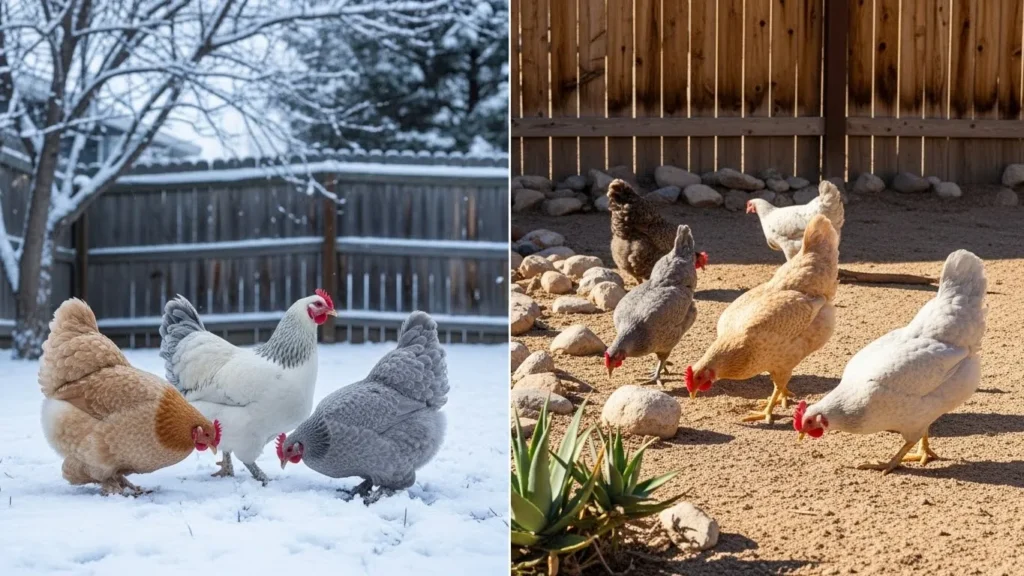
Pick one?
What’s your coldest winter temp? ___
What’s your hottest summer temp? ___
If winters below 20°F: Cold-hardy only
If summers above 90°F: Heat-tolerant only
If both: Adaptable breeds + management
Factor 3: Space Requirement
Space is physical reality. You can’t fake it.
Minimum Space Requirements
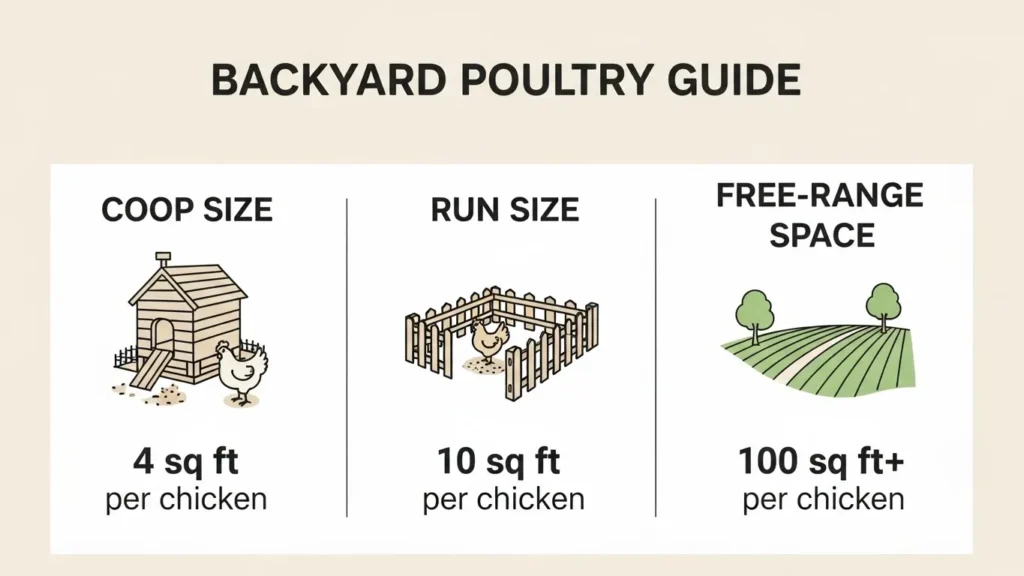
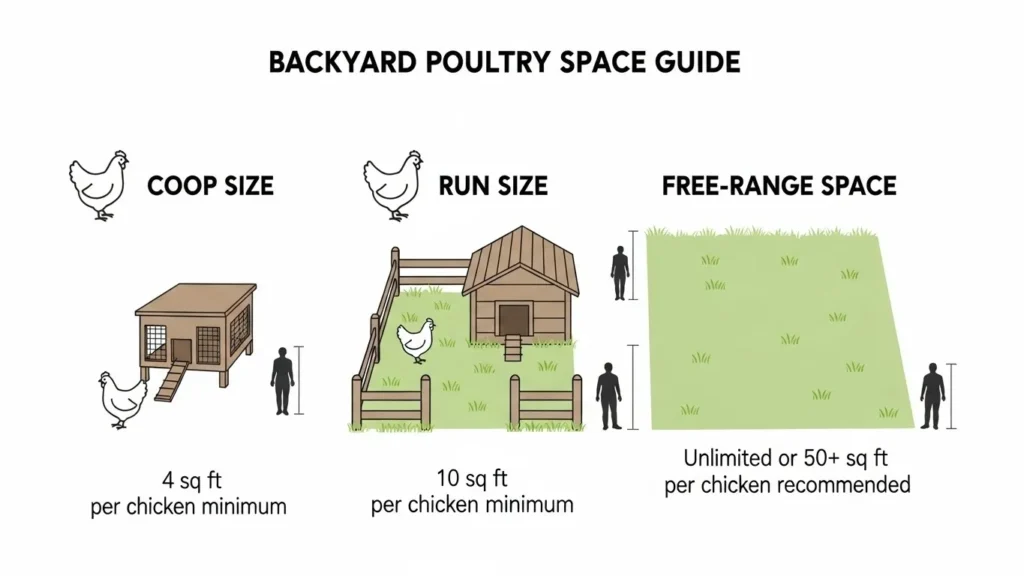
Coop (indoor): 4 sq ft per standard bird, 2 sq ft per bantam
Run (outdoor): 10 sq ft per standard bird, 5 sq ft per bantam
Free-range: 50-100 sq ft per bird ideal
According to poultry extension experts, inadequate space causes pecking, cannibalism, and disease. These are minimums—more is better.
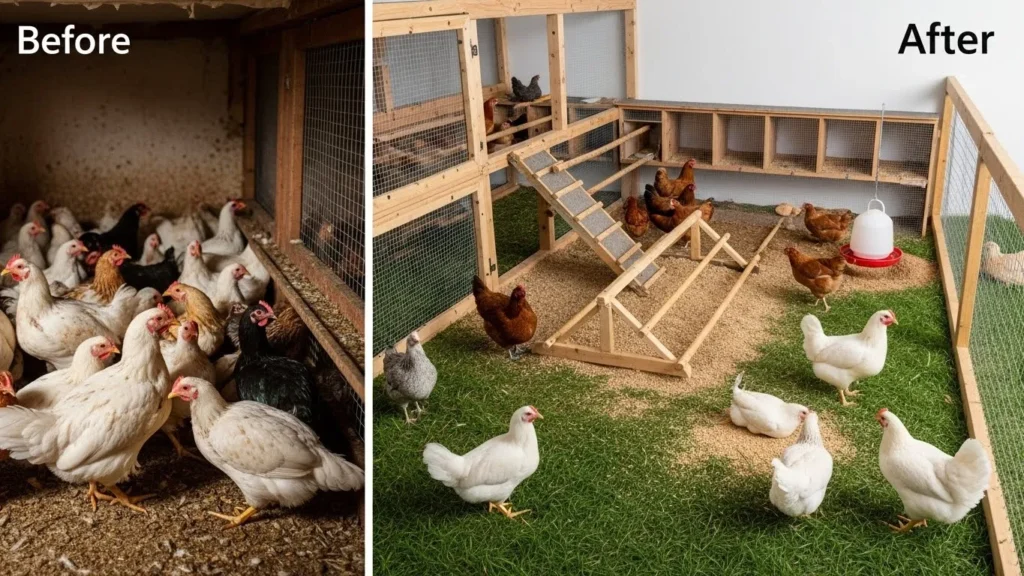
For Urban Settings (Under 500 sq ft total)
Space reality: Small coops, limited runs, close neighbors
Best breeds: Docile, quiet, confinement-tolerant
Top choices: Silkies (can’t fly), Cochins (heavy, calm), Orpingtons (docile), Australorps (quiet), Wyandottes (calm)
Avoid: Leghorns (flighty, need space), Rhode Island Reds (active), Mediterranean breeds (high energy)
Flock size: 3-4 hens maximum
Example: 4 hens need minimum 16 sq ft coop + 40 sq ft run = 56 sq ft total
For Rural Settings (2000+ sq ft or free-range)
Space characteristics: Large coops possible, extensive free-range, no neighbor concerns
Best breeds: Excellent foragers, independent, any activity level
Top choices: Any breed works, active foragers excel (Rhode Island Red, Leghorn, Australorp)
Flock size: 10-25+ birds possible
For Bantam (Space-Saving)
Size: 1/3 to 1/2 standard size
Space needs: 2 sq ft coop, 5 sq ft run per bird
Trade-offs: Smaller eggs (2 bantam = 1 standard), lower production, more vulnerable to predators
Best bantams: Cochin, Silkie, Serama, Wyandotte, Orpington
Space Calculations
Roosting bars: 10-12 inches per standard bird, 8 inches per bantam
Nesting boxes: One 12×12 inch box per 3-4 hens
Minimum headroom: 3-4 feet for human access
Example calculation for 6 standard hens:
- Coop minimum: 24 sq ft (4×6 structure)
- Run minimum: 60 sq ft
- Roost space: 60-72 inches (5-6 feet of bars)
- Nesting boxes: 2 boxes
According to BackYard Chickens forum, the 4 sq ft coop + 10 sq ft run rule apply for urban small flocks, not rural settings.
Effects of Overcrowding
Behavioral problems: Feather picking, aggression, bullying, egg eating
Health issues: Disease spread, respiratory problems, stress
Production decline: Reduced laying, poor egg quality
Solution: Always build bigger than minimum requirements
Factor 4: Match Your Experience Level
Some breeds forgive mistakes. Others punish them immediately.
Beginner-Friendly Breeds
What makes them beginner-friendly:
- Hardy, disease-resistant
- Calm, easy to handle
- Predictable behavior
- Widely available
- Standard care requirements
Top 10 beginner breeds:
- Australorp – Calm, 250-300 eggs, cold-hardy
- Buff Orpington – Gentle giants, friendly, 200-280 eggs
- Plymouth Rock – Reliable, steady, 200-280 eggs
- Rhode Island Red – Hardy, productive, 250-280 eggs
- Sussex – Friendly, adaptable, 250-280 eggs
- Wyandotte – Beautiful, cold-hardy, 200-250 eggs
- Easter Egger – Colorful eggs, hardy, friendly
- Brahma – Gentle, cold-hardy, impressive size
- Cochin – Docile, fluffy, good with kids
- Delaware – Underrated, adaptable, 250-280 eggs
Why they work: Forgiving of care mistakes, consistent temperament, no special needs, strong genetics.
Breeds to Avoid as Beginner
Leghorn – Flighty, hard to catch, nervous, large comb prone to frostbite
Ameraucana – Flighty, loud, unfriendly unless handled extensively as chicks
Rare heritage breeds – Limited info, expensive mistakes, special care, no local support
Ornamentals (Polish, Sultans) – Delicate, require grooming, special needs
Rural Sprout warns Leghorns are nervous, noisy, flighty, and suffer frostburn easily—poor beginners choice despite high production.
Pick one?
First-time keeper? → Choose only from top 10 beginner list
1-2 years experience? → Can try Marans, Welsummer, Leghorn
3+ years experience? → Ready for rare breeds, ornamentals, breeding projects
Factor 5: Time & Maintenance Requirements
Be honest about your schedule. Chickens you can’t care for suffer.
According to Durvet and Western Ranch Supply, chicken owners typically spend 10-20 minutes daily caring for chickens, plus 1-2 hours weekly for cleaning.
Daily tasks (15-30 minutes):
- Morning: Feed, water, let out, collect eggs
- Evening: Lock coop at dusk (predator protection)
Weekly tasks (30-60 minutes):
- Refresh coop bedding
- Scrub feeders and waterers
- Health checks
Low-Maintenance Breeds
Characteristics: Self-sufficient foragers, hardy, minimal grooming, standard care only
Best low-maintenance: Rhode Island Red, Australorp, Plymouth Rock, Sussex, Easter Egger, Delaware
Time: 15-20 minutes daily
Medium-Maintenance Breeds
Characteristics: Require monitoring, seasonal adjustments, occasional grooming
Examples: Wyandotte (dense plumage checks), Orpington (heavy feathering), Brahma (foot feathers need cleaning)
Time: 20-30 minutes daily
High-Maintenance Breeds
Characteristics: Frequent grooming, special needs, delicate health, climate control needed
Examples: Silkies (feathers need constant care, can’t get wet), Polish (head feathers block vision, need trimming), Frizzles (curly feathers need weather protection), Serama (tiny, fragile, temperature-sensitive)
Time: 30-60+ minutes daily
Avoid unless: You have time and dedication for specialized care
Time-Saving Strategies
Community Chickens recommends automation for low-maintenance setups: gravity feeders, automatic waterers, deep litter method, and keeping only 3-4 hens.
For busy schedules:
- Automatic feeders and waterers
- Deep litter method (clean 2-3 times yearly vs weekly)
- Small flock (3-4 birds)
- Low-maintenance breeds only
Factor 6: Family & Temperament Considerations
Kids change everything. Choose breeds that tolerate handling.
Best Breeds for Families with Children
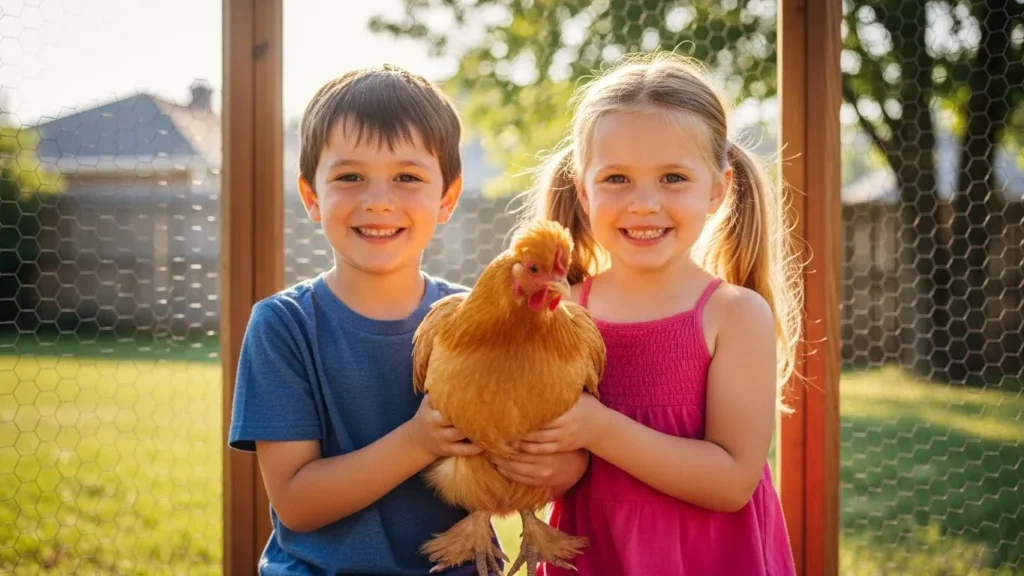
What makes them kid-friendly: Gentle, tolerant of handling, not easily startled, calm temperament
Top 10 family-friendly breeds:
- Silkies – Lap chickens, incredibly gentle, 100-120 eggs
- Buff Orpington – “Golden retrievers of chickens,” sweet, 200-280 eggs
- Cochin – Gentle giants, cuddly, fluffy, 150-180 eggs
- Australorp – Calm, easy-going, 250-300 eggs
- Plymouth Rock – Friendly, docile, 200-280 eggs
- Wyandotte – Beautiful, gentle, 200-250 eggs
- Easter Egger – Colorful eggs excite kids, friendly
- Brahma – Gentle despite size, 150-200 eggs
- Faverolles – Comical, cuddly, 180-200 eggs
- Sussex – Curious, friendly, 250-280 eggs
Safety with kids: Supervise young children always, teach gentle handling, enforce hand washing after handling
Breeds to Avoid with Children
Leghorn – Flighty, hard to catch, nervous around kids
Ameraucana – Can be unfriendly without extensive early handling
Game breeds – Naturally aggressive
Roosters generally – Can become aggressive at puberty, dangerous around small children
Backyard Poultry warns even friendly rooster breeds can become unpredictable—not recommended for families with kids under 10.
What about Rooster?
Generally calm roosters: Orpington, Cochin, Brahma, Australorp
Variable/potentially aggressive: Rhode Island Red, Plymouth Rock, any rooster can become territorial
Never keep roosters if: Urban/close neighbors, young children, limited experience, local ordinances prohibit
Factor 7: Budget Considerations
Chickens cost money. Some breeds cost more than others.
According to cost research, chicks are cheapest upfront but need most care before producing eggs.
Budget-Friendly Breeds
Best value (productive + affordable feed):
- Rhode Island Red
- Australorp
- Plymouth Rock
- Easter Egger
- Sussex
Expensive breeds:
- Giant breeds (Jersey Giant, Brahma)
- Rare heritage breeds
- Ornamentals (Silkie, Polish)
You’ve now narrowed 400+ breeds to a shortlist using all 7 factors.
Breed Recommendations by different Scenarios
Now apply your 7 factors to real situations.
Scenario 1: First-Time Urban Keeper
Situation: Small backyard (300 sq ft), close neighbors, family with kids ages 6 and 9, want eggs
Your 7 factors:
- Purpose: Eggs for family
- Climate: Moderate (Ohio)
- Space: Urban, limited
- Experience: Beginner
- Time: 20 minutes daily
- Family: Young children
- Budget: Moderate
Why: All tolerate confinement, quiet for neighbors, safe with kids, produce 12-16 eggs weekly
Scenario 2: Urban Homesteader
Situation: Suburban lot (1000 sq ft), want eggs + meat option, adults only, moderate experience
Your 7 factors:
- Purpose: Dual-purpose
- Climate: Cold winters
- Space: Suburban
- Experience: Some
- Time: 30 minutes daily
- Family: Adults
- Budget: Moderate
Why: Hens lay 30-40 eggs weekly, process roosters at 16-20 weeks, all cold-hardy
Scenario 3: Maximum Egg Production
Situation: Large property, free-range possible, experienced keeper, want maximum eggs for selling
Your 7 factors:
- Purpose: Maximum eggs
- Climate: Moderate
- Space: Rural, large
- Experience: Advanced
- Time: 30-40 minutes daily
- Family: Adults
- Budget: Focus on ROI
Why: 180-240 eggs weekly, free-range reduces feed costs, mix of hybrids and heritage
Scenario 4: Cold Climate Beginner
Situation: Minnesota (-20°F winters), new keeper, want reliable winter eggs, kids involved
Your 7 factors:
- Purpose: Eggs + family pets
- Climate: Extreme cold
- Space: Suburban
- Experience: Beginner
- Time: 20-30 minutes daily
- Family: Children
- Budget: Moderate
Why: Small combs prevent frostbite, dense feathering, continue laying in winter, gentle with kids
Scenario 5: Hot Climate Beginner
Situation: Arizona (100°F+ summers), limited experience, want eggs despite heat
Your 7 factors:
- Purpose: Eggs
- Climate: Extreme heat
- Space: Suburban
- Experience: Beginner
- Time: 20-30 minutes daily
- Family: Adults
- Budget: Moderate
Why: Large combs dissipate heat, lighter bodies, still productive in summer
According to Ohio State Extension, matching breeds to climate and experience level prevents most beginner failures.
Making Your Final Decision
You’ve worked through 7 factors. Time to finalize your choices.
Your Personal Shortlist
Step 1: Review your answers
- Purpose: ___
- Climate: ___
- Space: ___
- Experience: ___
- Time: ___
- Family: ___
- Budget: ___
Step 2: List 5-8 breeds that fit ALL factors
Step 3: Research each breed specifically
- Read breed reviews on BackYard Chickens forum
- Watch videos showing actual behavior
- Ask local keepers about their experience
Step 4: Pick 2-3 breeds for your flock
Grubbly Farms recommends starting with 2 breeds maximum for beginners—simpler management, easier to learn their needs.
Mixed Flock Guidelines
Beginner recommendation: 2 breeds total, 2-3 birds each
Example for 6 hens:
- 3 Rhode Island Red (great layers)
- 3 Buff Orpington (friendly, beautiful)
Benefits: Eggs if one breed slows, genetic diversity, interesting dynamics
Single breed alternative: Simpler care, predictable behavior, easier if breeding later
Where to Buy?
Reputable hatcheries: Cackle, Meyer, Murray McMurray, My Pet Chicken
Local options: Feed stores (seasonal), local breeders, poultry shows
What to avoid: No health guarantees, can’t see parent stock, overcrowded facilities